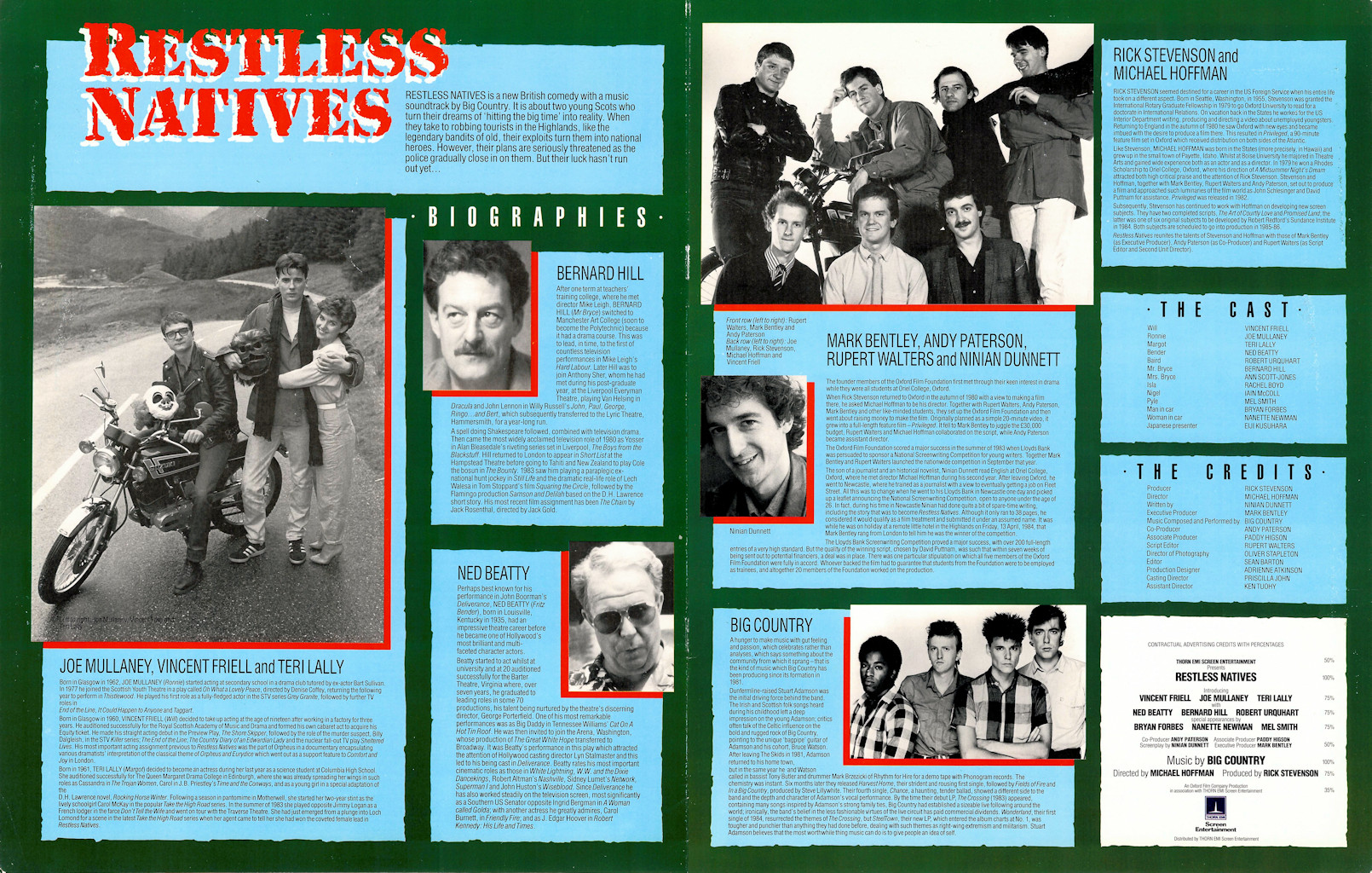
JOE MULLANEY, VINCENT FRIELL and TERI LALLY
Born in Glasgow in 1962, JOE MULLANEY (Ronnie) started acting at secondary school in a drama club tutored by ex-actor Bart Sullivan. In 1977 he joined the Scottish Youth
Theatre in a play called Oh What A Lovely Peace, directed by denise Coffey, returning the following year to perform in Thistlewood. He played his first
role as a fully-fledged actor in the STV series Grey Granite, followed by further TV roles in End of the Line, It Could Happen to Anyone and
Taggart.
Born in Glasgow in 1960, VINCENT FRIELL (Will) decided to take up acting at the age of nineteen after working in a factory for three years. He auditioned successfully for
the Royal Scottish Academy of Music and Drama and formed his own cabaret act to acquire his Equity ticket. He made his straight acting debut in the Preview play, The Shore
Skipper, followed by the role of the murder suspect, Billy Dalgleish, the STV Killer series; TheEnd of the Line; The Country Diary of an Edwardian Lady and
the nuclear fall-out TV play Sheltered Livves. His most important acting assignment previous to Restless Natives was the part of Orpheuss in a documentary
encapsulating various dramatists' interpretation of the classical theme of Orpheus and Eurydicem which went out as a support feature to Comfort and Joy in London.
Born in 1961, TERI LALLY (Margot) decided to become an actress during her last year as a science student at Columbia High School. She autitioned successfully for The Queen
Margaret Dram College in Edinburgh, where she was already spreading her wings in such roles as Cassandra in The Trojan Women, Carol in J.B. Priestley's Time and the
Conways, and as a young girl in a special adaptation of the D.H. Lawrence novel, Rocking Horse Winter. Following a season in pantomime in Motherwell, she started her
two-year stint as the lively schoolgirl Carol McKay in the popular Take the High Road series. In the summer of 1983 she played opposite Jimmy Logan as a French lodger in
the farce Don't tell the Wife and went on tour with the Traverse Theatre .She had just emrged from a plunge into Loch Lomon for a scene in the latest Take the High Road
series when her agent came to tell her she had won the coveted female lead in Restless Natives.
BERNARD HILL
After one term at teachers' training college, where he met director Mike Leigh, BERNARD HILL (Mr Bryce) switches to Manchester Art College (soon to become the Polytechnic) because
it had a drama course. This was to lead, in time, to the first of countless telivsion performances in Mike Leigh's Hard Labour. Later Hill was to join Anthony Sher, whom
he had met during his post-graduate year, at the Liverpool Everyman Theatre, playing Van Helsing in Dracula and John Lennon in Willy Russell's John, Paul, George,
Ringo...and Bert, which subsequently transferred to the Lyric Theatre, Hammersmith, for a year-long run.
A spell doing Shakespeare followed, combined with television drama. Then came the most widely acclaimed television role of 1980 as Yosser in Alan Bleasdale's riveting series set in
Liverpool, The Boys from the Black Stuff. Hill returned to London to appear in Short List at the Hampstead Theatre before going to Tahiti and New Zealand to play
Cole the bosun in The Bounty. 1983 saw him playing a paraplegic ex-national hunt jockey in Still Life and the dramatic real-life role of Lech Walesa in Tom
Stoppard's film Squaring the Circle, followed by the Flamingo production Samsonn and Delilah based on the D.H. Lawrence short story. His most recent film assignment
has been The Chain by Jack Rosenthal, directed by Jack Gold.
NED BEATTY
Perhaps best known for his performance in John Boorman's Deliverance, NED BEATTY (Fritz Bender), born in Louisville, Kentucky in 1935, had an impressive theatre
career before he became one of Hollywood's most brilliant and multi-faceted character actors.
Beatty started to act whilst at university and at 20 auditioned successfully for the Barter Theatre, Virginia where, over seve years, he graduated to leading roles in some 70
productions, his talent being nurtured by the theatre's discerning direcor, George Porterfield. One of his most remarkable peformances was as Big Daddy in Tennessee Williams' Cat
On A Hot Tin Roof. He was then invited to join the Arena, Washington, whose production of The Great White Hope transferred to Broadway. It was Beatty's performance in
this play which attracted the attention of Hollywood casting director Lyn Stalmaster and this led to his being cast in Deliverance. Beatty rated his most important cinematic
roles as those in White Lightning, W.W. and the Dixie Dancekings, Robert Altman's Nashville, Sidney Lumet's Network, Superman I and John Huston's
Wiseblood. Since Deliverance he has also worked steadily on the television screen, most dignificantly as a Southern US Senator opposite Indgrid Bergman in A
Woman called Golda; with another actress he greatly admires, Carol Burnett, in Friendly Fire; and as J. Edgar Hoover in Robert Kennedy: His Life and Times.
MARK BENTLEY, ANDY PATERSON, RUPERT WALTERS and NINIAN DUNNETT
The founder members of the Oxford Film Foundation first me through their keen interest in drama while they were all students at Oriel College, Oxford.
When Rick Stevenson returned to Oxford in the autumn of 1980 with a view to making a film there, he asked Michael Hoffman to be his director. Together with Rupert Walters, Andy
Patterson, Mark Bentley and other like-minded students, they set up the Oxford Film Foundation and then went about raising money to make the film. Originally planned as a simple
20-minute video, it grew into a full-length feature film - Privileged. It fell to Mark Bentley to juggle the £30,000 budge, Rupert Walters launched the nationwide competition
in September that year.
The son of a journalisst and an historical novelist, Ninian Dunnett read English at Oriel College, Oxford, where he met director Michael hoffman during his second year. After leaving
Oxford, he went to Newcastle, where he trained as a journalist with a view to eventually getting a job on Fleet Street. All this was to change when he went to his Lloyds Bank in
Newcastle one day and picked up a leaflet announcing the National Screenwriting Competition, open to anyone under the age of 26. In fact, during his time in newcastle, Ninian had done
quite a bit of spare-time writing, including the story that was to become Restless Natives. Although it only ran to 38 pages, he considered it would qualify as a film
treatment and submitted it under an assumed name. It was while he was on holiday at a remote little hotel in the Highlands on Friday, 13th April, 1984, that Mark Bentley rang from
London to tell him he was the winnder of the competiion.
The Lloyds Bank Screenwriting Competiion proved a major success, with over 200 full-length entries of a very high standard. But the quality of the winning script, chosen by David Puttnam,
was such that within seven weeks of being sent out to potential financiers, a deal was in place. There was one particular stipulation on which all five members of the Oxford Film
Foundation were fully in accord. Whoever backed the film had to guarantee that students from the Foundation were to be employed as trainees, and altogether 20 members of the Foundation
worked on the production.
BIG COUNTRY
A hunger to make music with gut feeling and passion, which celebrates rather than analyses, which says something about the community from which it sprang - that is the kind of music
which Big Country has been producing since its formation in 1981.
Dunfermline-raised Staurt Adamson was the initial driving force behind the band. The Irish and Scottish folk songs heard during his childhood left a deep impression on the young Adamson
and his cohort, Bruce Watson. After leaving The Skids in 1981, Adamson returned to his home town, but int he same year he and Watson called in bassist Tony Butler and drummer Mark
Brzezicki of Rhythm for Hire for a demo tape with Phonogram records. The chemistry was instant. Six months later they released Harvest Home, their strident and rousing first
single, followed by Fields of Fire and In a Big Country, produced by Steve Lillywhite. Their fourth single, Chance, a haunting, tender ballad, showed a
different side to the band and the depth and character of Adamson's vocal performance. By the time their debut LP, The Crossing (1983) appeared, containing many songs inspired
by Adamson's strong family ties, Big Country had established a sizeable live following around the world; ironically, the band's belief in the less fashionable virtues of the live circuit
has paid commerical dividends. Wonderland, their first single of 1984, resurrected the themes of The Crossing, but Steeltown, their new LP, which entered the
album charts at No. 1, was tougher and punchier than anything they had done before, dealing with such themes as right-wing extremism and militarism. Stuart Adamson believes that the most
worthwhile thing music can do is to give people an idea of self.
RICK STEVENSON and MICHAEL HOFFMAN
RICK STEVENSON seemed destined for a career in teh US Foreign Service when his entire life took on a different aspect. Born is Seattle, Washington, in 1955, Stevenson was granted the
International Rotary Graduate Fellowship in 1979 to go to Oxford University to read for a doctorate in Internation Relations. On vacation back in the States he worked for the US Interior
Department writing, producing and directing a video about unemployed youngsters. Returning to England in the autumn of 1980 he saw Oxford with new eyes and became imbued with the desire
to produce a film there. This resulted in Privileged, a 90-minute feature film set in Oxford which received distribution on both sides of the Atlantic.
Like Stevenson, MICHAEL HOFFMAN was born in the States (more precisely, in Hawaii) and grew up in the small town of Payette, Idaho. Whilst at Boise University he majored in Theatre Arts
and gained wide experience both as an actor and as a director. In 1979 he won a Rhodes Scholarship to Oriel College, Oxford, where his direction of A Midsummer Night's Dream,
attracted both high critical praise and the attention of Rick Stevenson. Stevenson and Hoffman, together with Mark Bentley, Rupert walters and Andy Paterson, set out to produce a film
and approached such luminaries of the film world as John Schlesinger and David Puttnam for assistance. Privileged was released in 1982.
Subsequently, Stevenson has continued to work with Hoffman on developing new screen subjects. They have completed two scripts, The Art of Courtly Love and Promised Land;
the latter was one of six original subjects to be developed by Robert Reedford's Sundance Institute in 1984. Both subjects are scheduled to go into production in 1985-86.
Restless Natives reunited the talents of Stevenson and Hoffman with those of Mark Bentley (as Executive Producer), Andy Paterson (as Co-Producer) and Rupert Walters (as Script
Editor and Second Unit Director).
|