(Click thumbnails for full size images.)
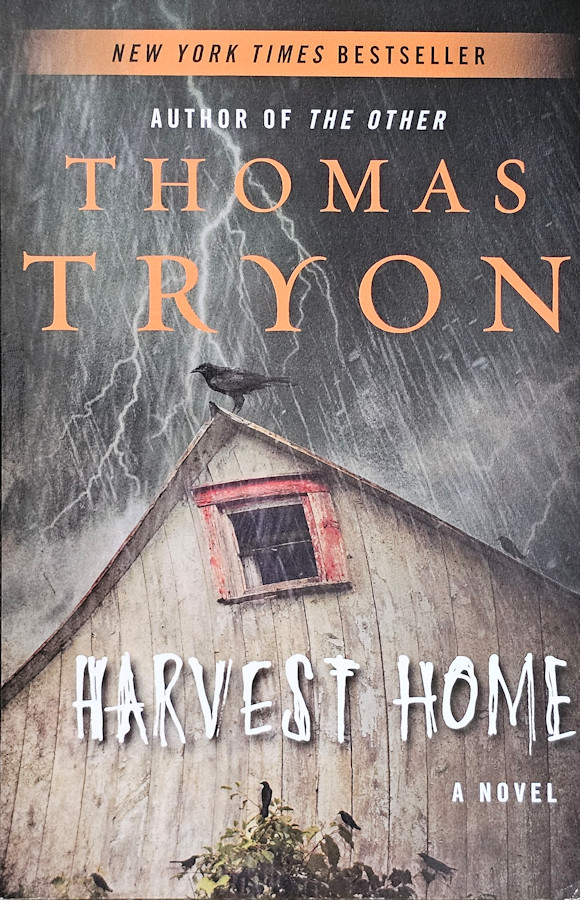
| This is the story about a family who move from New York to a remote Connecticut village called Cornwall Coombe, where sinister 17th-century pagan traditions rule, written by Thomas Tryon and first published in 1973. The book shares its name with Big Country's first single, which also appears on their first album "The Crossing". |
|
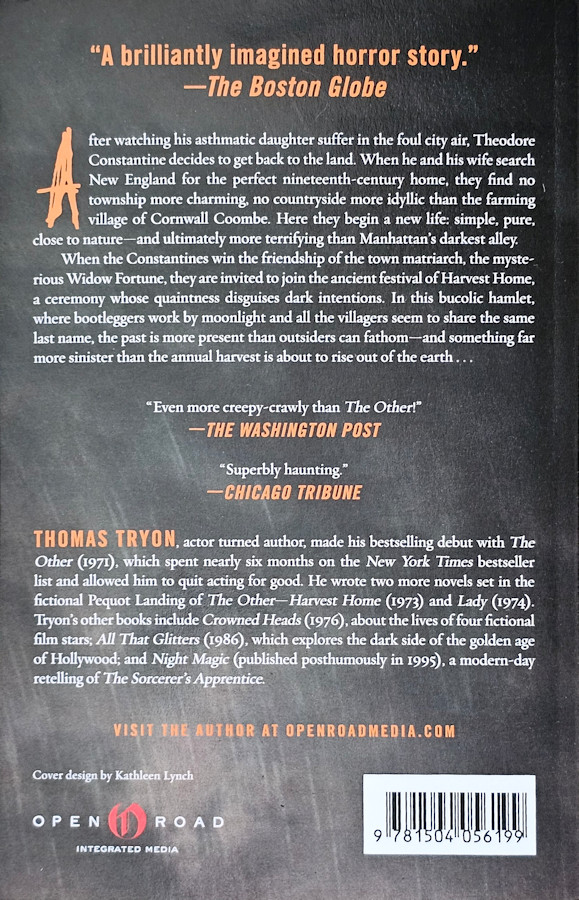
After watching his asthmatic daughter suffer in the foul city air, Theodore Constantine decides to get back to the land. When he and his wife search New England for the perfect nineteenth-century home, they find no
township more charming, no countryside more idyllic than the farming village of Cornwall Coombe. Here they begin a new life: simple, pure, close to nature-and ultimately more terrifying than Manhattan's darkest alley.
When the Constantines win the friendship of the town matriarch, the mysterious Widow Fortune, they are invited to join the ancient festival of Harvest Home, a ceremony whose quaintness disguises dark intentions. In
this bucolic hamlet, where bootleggers work by moonlight and all the villagers seem to share the same last name, the past is more present than outsiders can fathom-and something far more sinister than the annual
harvest is about to rise out of the earth....
|
|
While Thomas Tryon's 1973 folk horror novel and Stuart Adamson's Scottish rock band's debut single released on 17th September 1982, share the title "Harvest Home", their connection is a case of shared thematic
imagery and creative coincidence rather than a direct adaptation.
Parallels in "Uplifting Music vs. Dark Themes" |
|
Though Stuart Adamson did not write the song as a literal summary of Tryon's book, both works share an eerie juxtaposition of rural celebration and underlying dread:
The Traditional Ritual: In both the book and the song, "Harvest Home" refers to the traditional autumn festival celebrating the final gathering of the crop. The Dark Reality: In Tryon's novel, the beautiful autumn harvest masks a horrific, primitive pagan sacrifice. In Adamson's lyrics, the traditional festival is subverted into a dark social commentary. The song features lines like "Who left the future wasting / Who watched the families go... See where the altars creak", matching the bleak, sacrificial tone of folk horror. |
|
Adamson's Actual Inspiration While a fan of literature might spot the folk-horror vibe in the track, Stuart Adamson explicitly stated in a 1983 "Smash Hits" interview that his inspiration came from Scottish history: |
|
The Highland Clearances: Adamson noted the song was heavily influenced by the aftermath of the Battle of Culloden and the forced eviction of Scottish farmers by wealthy landlords ("How did the
landlord dine / Just as you sow you shall reap").
Modern Hardship: He used the historic "Harvest Home" imagery as a metaphor for the 1980s economic collapse of the Scottish oil boom, where working-class people were left displaced and impoverished. |
| The primary link is how both the American novelist and the Scottish songwriter independently took the comforting, pastoral concept of a "Harvest Home" festival and stripped it away to expose something much more unsettling underneath. |