January 1992
|
Modern Drummer January 1992 |
|
|
| Page 1 · Pages 20 & 21 · Pages 22 & 23 · Pages 24 & 25 · Pages 26 & 27 · Pages 72 & 73 · Page 76 · Page 78 · Page 80 · Page 82 |
 Back to top |
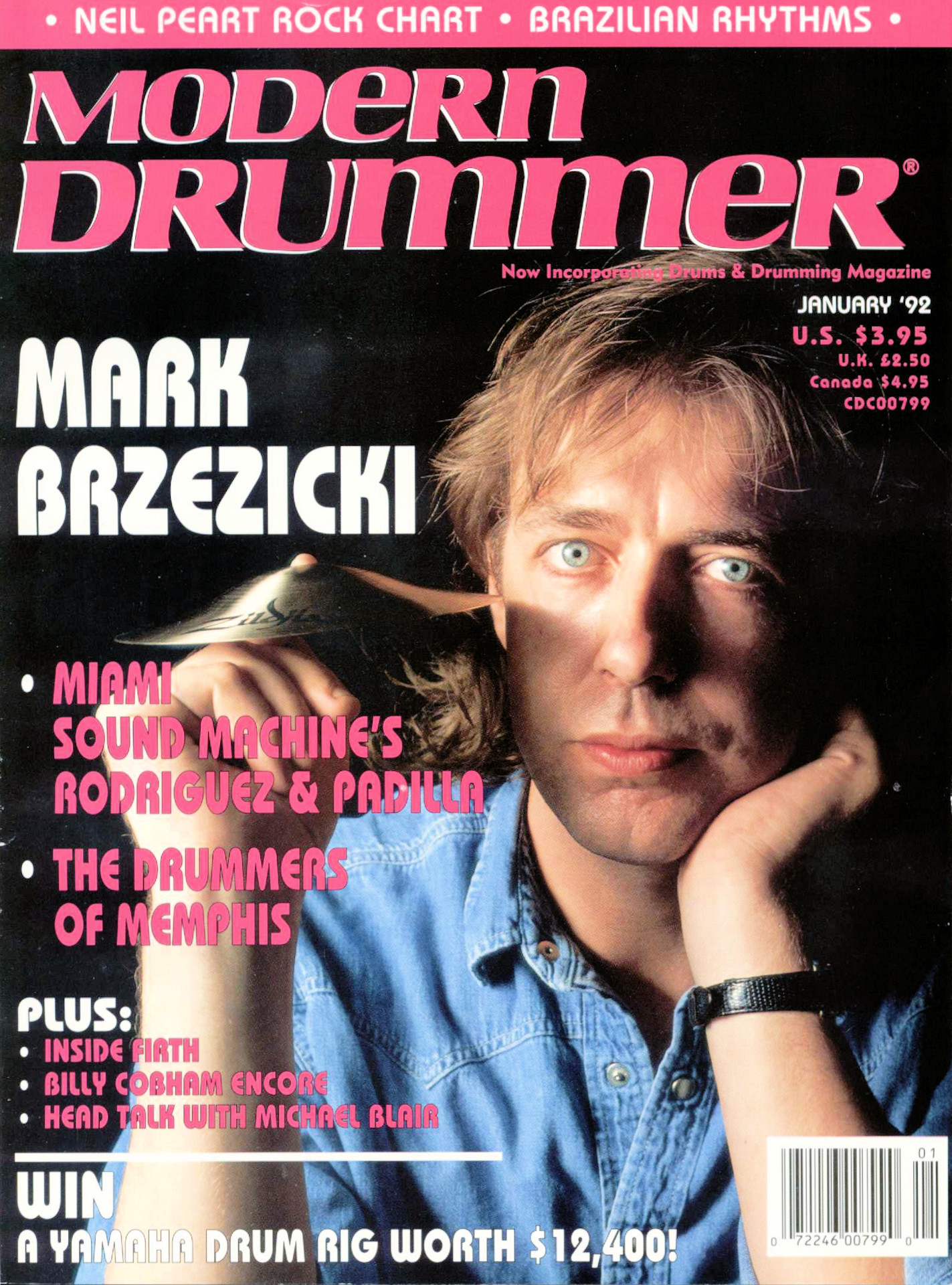
Front Cover Mark Brezezicki (cover photo) Other features Plus: WIN A Yamaha drum rig worth $12,400! |
|||||||||||||||||||||||||||||||||||||||||||||||||||||||||||||||||||||||||||||||||||
 Back to top |
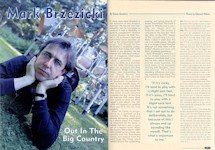
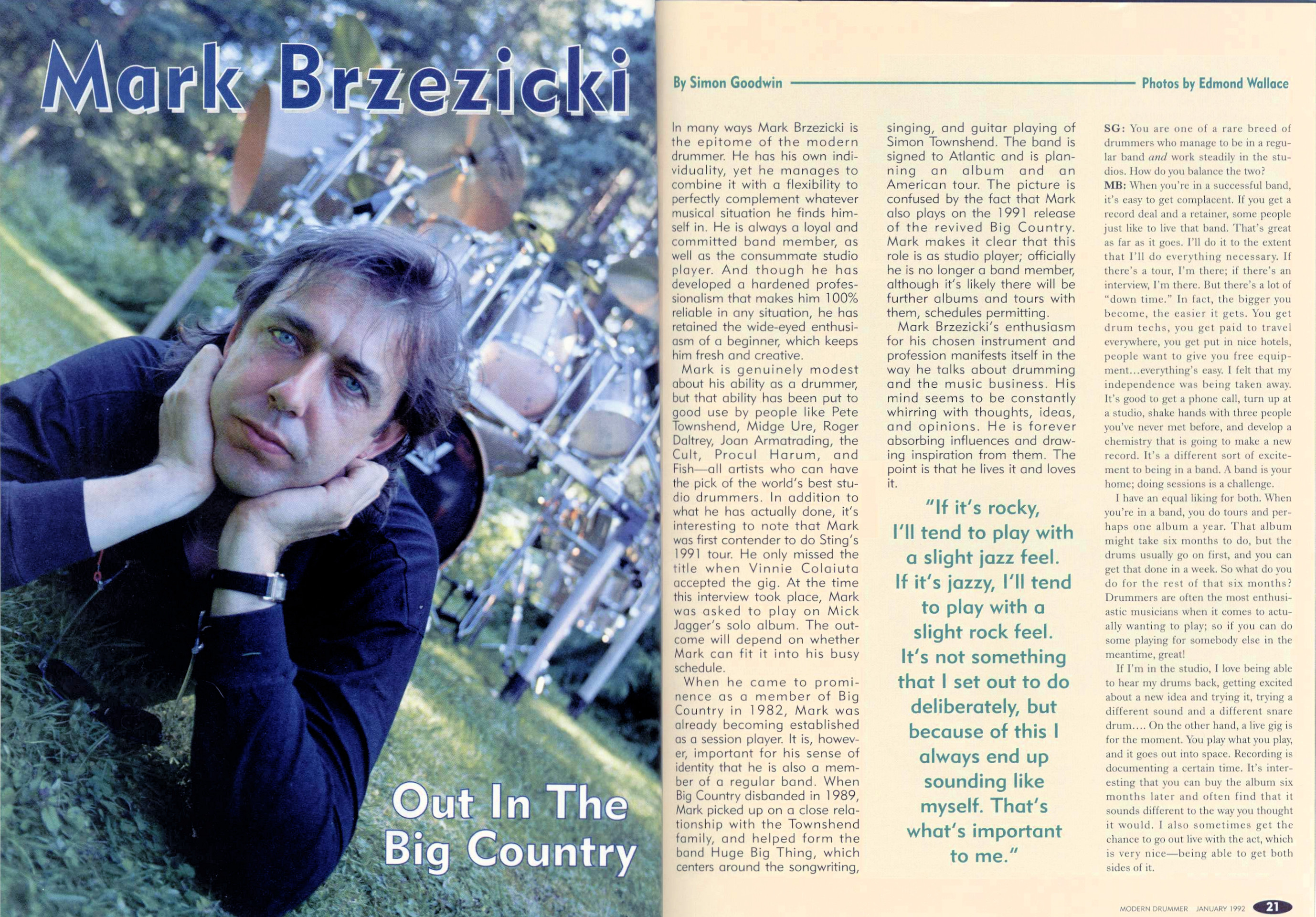
Pages 20 & 21 Mark Brzezicki - Out In The Big Country By Simon Goodwin. Photos by Edmond Wallace In many ways mark Brzezicki is the epitome of the modern drummer. He has his own individuality, yet he manages to combine it with a flexibility to perfectly compliment whatever musical situation he finds himself in. he is always a loyal and committed band member, as well as the consummate studio player. And though he has developed a hardened proffesionalism that makes him 100% reliable in any situation, he has retained the wide-eyed enthusiasm of a beginner, which keeps him fresh and creative. Mark is genuinely modest about his ability as a drummer, but that ability has been put to good use by people like Pete Townshend, Midge Ure, Roger Daltrey, Joan Armatrading, the Cult, Procul Harum, and Fish-all artists who can have the pick of the world's best studio drummers. In addition to what he has actually done, it's interesting to note that Mark was first contender to do Sting's 1991 tour. He only missed the title when Vinnie Colaiuta accepted the gig. At the time this interview took place, Mark was asked to play on Mick Jagger's solo album. The outcome will depend on whether Mark can fit it into his busy schedule. When he came to prominence as a member of Big Country in 1982, Mark was already becoming established as a session player. It is, however, important for his sense of identity that he is also a member of a regular band. When Big Country disbanded in 1989, Mark picked up on a close relationship with the Townshend family, and helped form the band Huge Big Thing, which centers around the songwriting, singing, and guitar playing of Simon Townshend. The band is signed to Atlantic and is planning an album and a American tour. The picture is confused by the fact that Mark also plays on the 1991 release of the revived Big Country. Mark makes it clear that this role is as studio player; officially he is no longer a band member, although it's likely there will be further albums and tours with them, schedules permitting. Mark Brzezicki's enthusiasm for his chosen instrument and profession manifests itself in the way he talks about drumming and the music business. His mind seems to be constantly whirring with thoughts, ideas, and opinions. He is forever absorbing influences and drawing inspiration from them. The point is that he lives it and loves it. SG: You are one of a rare breed of drummers who manage to be in a regular band and work steadily in the studios. How do you balance the two? MB: When you're in a successful band, it's easy to get complacent. If you get a record deal and a retainer, some people just like to live that band. That's great as far as it goes. I'll do it to the extent that I'll do everything necessary. If there's a tour, I'm there; if there's an interview, I'm there. But there's a lot of "down time." In fact, the bigger you become, the easier it gets. You get drum techs, you get paid to travel everywhere, you get put in nice hotels, people want to give you free equipment ... everything's easy. I felt that my independence was being taken away. It's good to get a phone call, turn up at a studio, shake hands with three people you've never met before, and develop a chemistry that is going to make a new record. It's a different sort of excitement to being in a band. A band is your home; doing sessions is a challenge. I have an equal liking for both. When you're in a band, you do tours and perhaps one album a year. That album might take six months to do, but the drums usually go on first, and you can get that done in a week. So what do you do for the rest of that six months? Drummers are often the most enthusiastic musicians when it comes to actually wanting to play; so if you can do some playing for somebody else in the meantime, great! If I'm in the studio, I love being able to hear my drums back, getting excited about a new idea and trying it, trying a different sound and a different snare drum .... On the other hand, a live gig isfor the moment. You play what you play, and it goes out into space. Recording is documenting a certain time. It's interesting that you can buy the album six months later and often find that it sounds different to the way you thought it would. I also sometimes get the chance to go out live with the act, which is very nice-being able to get both sides of it. |
|||||||||||||||||||||||||||||||||||||||||||||||||||||||||||||||||||||||||||||||||||
 Back to top |
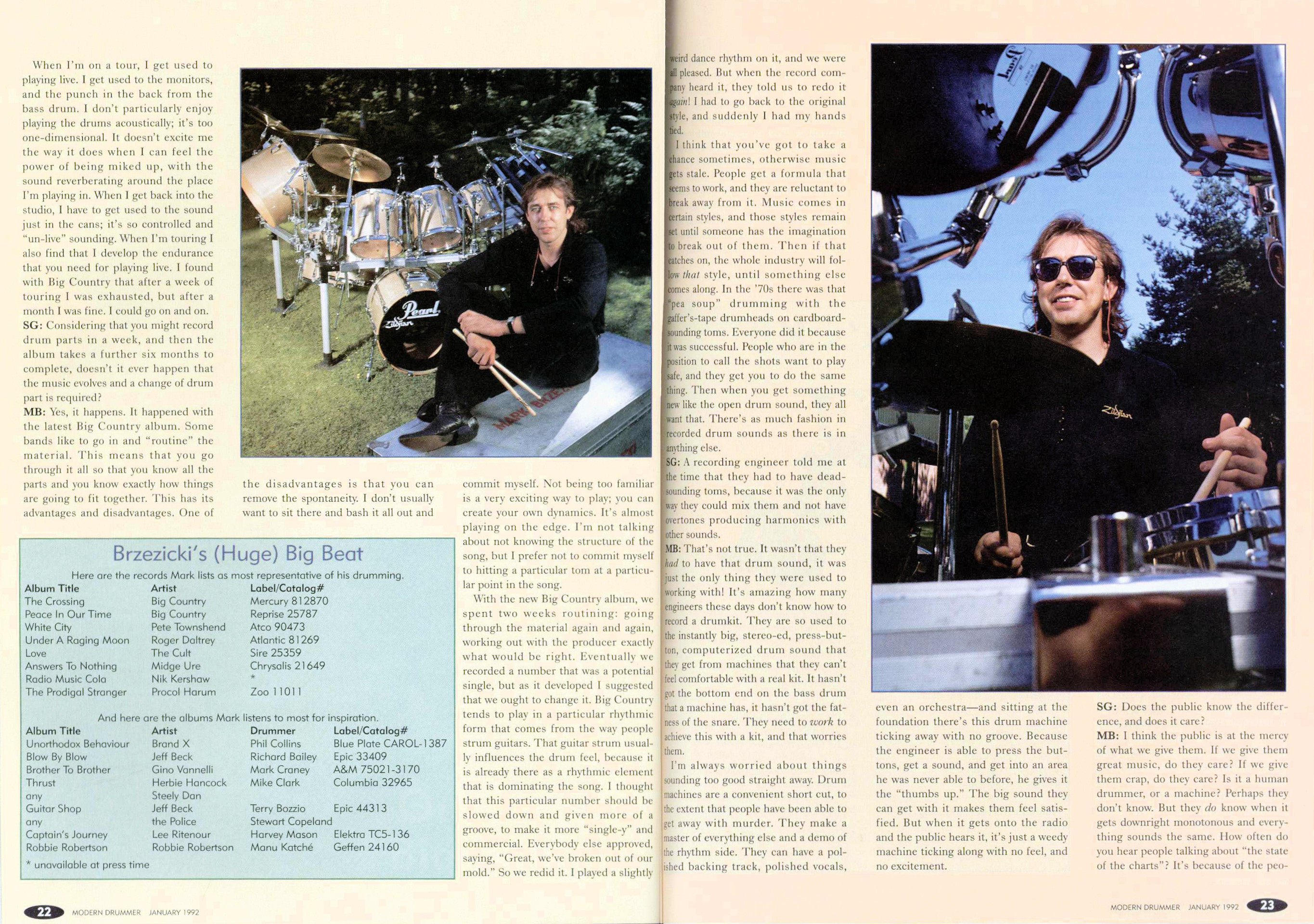
Pages 22 & 23 Mark Brzezicki interview (cont.) When I'm on a tour, I get used to playing live. I get used to the monitors, and the punch in the back from the bass drum. I don't particularly enjoy playing the drums acoustically; it's too one-dimensional. It doesn't excite me the way it does when I can feel the power of being miked up, with the sound reverberating around the place I'm playing in. When I get back into the studio, I have to get used to the sound just in the cans; it's so controlled and "un-live" sounding. When I'm touring I also find that I develop the endurance that you need for playing live. I found with Big Country that after a week of touring I was exhausted, but after a month I was fine. I could go on and on. SG: Considering that you might record drum parts in a week, and then the album takes a further six months to complete, doesn't it ever happen that the music evolves and a change of drum part is required? MB: Yes, it happens. It happened with the latest Big Country album. Some bands like to go in and "routine" the material. This means that you go through it all so that you know all the parts and you know exactly how things are going to fit together. This has its advantages and disadvantages. One of the disadvantages is that you can remove the spontaneity. I don't usually want to sit there and bash it all out and commit myself. Not being too familiar is a very exciting way to play; you can create your own dynamics. It's almost playing on the edge. I'm not talking about not knowing the structure of the song, but I prefer not to commit myself to hitting a particular tom at a particular point in the song.
With the new Big Country album, we spent two weeks routining: going through the material again and again, working out with the producer exactly what would be right. Eventually we recorded a number that was a potential single, but as it developed I suggested that we ought to change it. Big Country tends to play in a particular rhythmic form that comes from the way people strum guitars. That guitar strum usually influences the drum feel, because it is already there as a rhythmic element that is dominating the song. I thought that this particular number should be slowed down and given more of a groove, to make it more "single-y" and commercial. Everybody else approved, saying, "Great, we've broken out of our mold." So we redid it. I played a slightly wierd dance rhythm on it , and we were all pleased. But when the record company hear it, they told us to redo it again! I had to go back to the original style, and suddenly I had my hands tied. I think that you've got to take a chance sometimes, otherwise music gets stale. People get a formula that seems to work, and they are reluctant to break away from it. Music comes in certain styles, and those styles remain set until someone has the imagination to break out of them. Then if that catches on, the whole industry will follow that style, until something else comes along. In the '70s there was that "pea soup" drumming with the gaffer's-tape drumheads on cardboard-sounding toms. Everyone did it because it was successful. People who are in the position to call the shots want to play safe, and they get you to do the same thing. Then when you get something new like the open drum sound, they all want that. There's as much fashion in recorded drum sounds as there is in anything else. SG: A recording engineer told me at the time that they had to have dead-sounding toms, because it was the only way they could mix them and not have overtones producing harmonics with other sounds. MB: That's not true. It wasn't that they had to have that drum sound, it was just the only thing they were used to working with! It's amazing how many engineers these days don't know how to record a drumkit. They are so used to the instantly big, stereo-ed, press-button, computerized drum sound that they get from machines that they can't feel comfortable with a real kit. It hasn't got the bottom end on the bass drum that a machine has, it hasn't got the fatness of the snare. They need to work to achieve this with a kit, and that worries them. I'm always worried about things sounding too good straight away. Drum machines are a convenient short cut, to the extent that people have been able to get away with murder. They make a master of everything else and a demo of the rhythm side. They can have a polished backing track, polished vocals, even an orchestra-and sitting at the foundation there's this drum machine ticking away with no groove. Because the engineer is able to press the buttons, get a sound, and get into an area he was never able to before, he gives it the "thumbs up." The big sound they can get with it makes them feel satisfied. But when it gets onto the radio and the public hears it, it's just a weedy machine ticking along with no feel, and no excitement. SG: Does the public know the difference, and does it care? MB: I think the public is at the mercy of what we give them. If we give them great music, do they care? If we give them crap, do they care? Is it a human drummer, or a machine? Perhaps they don't know. But they do know when it gets downright monotonous and everything sounds the same. How often do you hear people talking about "the state of the charts"? It's because of the peo- |
|||||||||||||||||||||||||||||||||||||||||||||||||||||||||||||||||||||||||||||||||||
 Back to top |
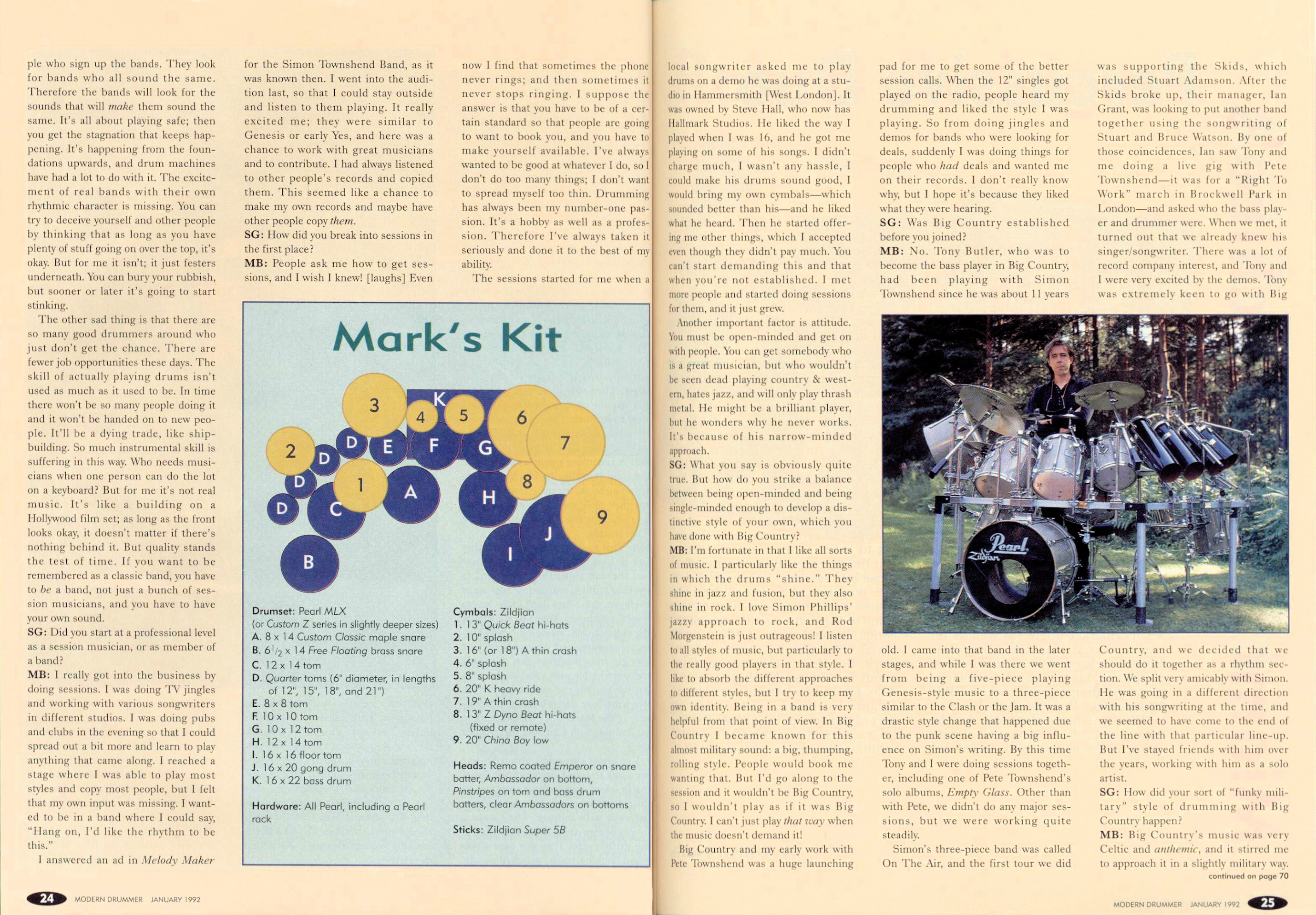
Pages 24 & 25 Mark Brzezicki interview (cont.) ple who sign up the bands. They look for bands who all sound the same. Therefore the bands will look for the sounds that will make them sound the same. It's all about playing safe; then you get the stagnation that keeps happening. It's happening from the foundations upwards, and drum machines have had a lot to do with it. The excitement of real bands with their own rhythmic character is missing. You can try to deceive yourself and other people by thinking that as long as you have plenty of stuff going on over the top, it's okay. But for me it isn't; it just festers underneath. You can bury your rubbish, but sooner or later it's going to start stinking. The other sad thing is that there are so many good drummers around who just don't get the chance. There are fewer job opportunities these days. The skill of actually playing drums isn't used as much as it used to be. In time there won't be so many people doing it and it won't be handed on to new people. It'll be a dying trade, like ship-building. So much instrumental skill is suffering in this way. Who needs musicians when one person can do the lot on a keyboard? But for me it's not real music. It's like a building on a Hollywood film set; as long as the front looks okay, it doesn't matter if there's nothing behind it. But quality stands the test of time. If you want to be remembered as a classic band, you have to be a band, not just a bunch of session musicians, and you have to have your own sound. SG: Did you start at a professional level as a session musician, or as member of a band? MB: I really got into the business by doing sessions. I was doing TV jingles and working with various songwriters in different studios. I was doing pubs and clubs in the evening so that I could spread out a bit more and learn to play anything that came along. I reached a stage where I was able to play most styles and copy most people, but I felt that my own input was missing. I wanted to be in a band where I could say, "Hang on, I'd like the rhythm to be this." I answered an ad in Melody Maker for the Simon Townshend Band, as it was known then. I went into the audition last, so that I could stay outside and listen to them playing. It really excited me; they were similar to Genesis or early Yes, and here was a chance to work with great musicians and to contribute. I had always listened to other people's records and copied them. This seemed like a chance to make my own records and maybe have other people copy them.
SG: How did you break into sessions in the first place? MB: People ask me how to get sessions, and I wish I knew! [laughs] Even now I find that sometimes the phone never rings; and then sometimes it never stops ringing. I suppose the answer is that you have to be of a certain standard so that people are going to want to book you, and you have to make yourself available. I've always wanted to be good at whatever I do, so I don't do too many things; I don't want to spread myself too thin. Drumming has always been my number-one passion. It's a hobby as well as a profession. Therefore I've always taken it seriously and done it to the best of my ability. The sessions started for me when a local songwriter asked me to play drums on a demo he was doing at a studio in Hammersmith [West London]. It was owned by Steve Hall, who now has Hallmark Studios. He liked the way I played when I was 16, and he got me playing on some of his songs. I didn't charge much, I wasn't any hassle, I could make his drums sound good, I would bring my own cymbals-which sounded better than his-and he liked what he heard. Then he started offering me other things, which I accepted even though they didn't pay much. You can't start demanding this and that when you're not established. I met more people and started doing sessions for them, and it just grew. Another important factor is attitude. You must be open-minded and get on with people. You can get somebody who is a great musician, but who wouldn't be seen dead playing country & western, hates jazz, and will only play thrash metal. He might be a brilliant player, but he wonders why he never works. It's because of his narrow-minded approach. SG: What you say is obviously quite true. But how do you strike a balance between being open-minded and being single-minded enough to develop a distinctive style of your own, which you have done with Big Country? MB: I'm fortunate in that I like all sorts of music. I particularly like the things in which the drums "shine." They shine in jazz and fusion, but they also shine in rock. I love Simon Phillips' jazzy approach to rock, and Rod Morgenstein is just outrageous! I listen to all styles of music, but particularly to the really good players in that style. I like to absorb the different approaches to different styles, but I try to keep my own identity. Being in a band is very helpful from that point of view. In Big Country I became known for this almost military sound: a big, thumping, rolling style. People would book me wanting that. But I'd go along to the session and it wouldn't be Big Country, so I wouldn't play as if it was Big Country. I can't just play that way when the music doesn't demand it! Big Country and my early work with Pete Townshend was a huge launching pad for me to get some of the better session calls. When the 12" singles got played on the radio, people heard my drumming and liked the style I was playing. So from doing jingles and demos for bands who were looking for deals, suddenly I was doing things for people who had deals and wanted me on their records. I don't really know why, but I hope it's because they liked what they were hearing. SG: Was Big Country established before you joined? MB: No. Tony Butler, who was to become the bass player in Big Country, had been playing with Simon Townshend since he was about 11 years old. I came into that band in the later stages, and while I was there we went from being a five-piece playing Genesis-style music to a three-piece similar to the Clash or the Jam. It was a drastic style change that happened due to the punk scene having a big influence on Simon's writing. By this time Tony and I were doing sessions together, including one of Pete Townshend's solo albums, Empty Glass. Other than with Pete, we didn't do any major sessions, but we were working quite steadily. Simon's three-piece band was called On The Air, and the first tour we did was supporting the Skids, which included Stuart Adamson. After the Skids broke up, their manager, Ian Grant, was looking to put another band together using the songwriting of Stuart and Bruce Watson. By one of those coincidences, Ian saw Tony and me doing a live gig with Pete Townshend-it was for a "Right To Work" march in Brockwell Park in London-and asked who the bass player and drummer were. When we met, it turned out that we already knew his singer/songwriter. There was a lot of record company interest, and Tony and I were very excited by the demos. Tony was extremely keen to go with Big Country, and we decided that we should do it together as a rhythm section. We split very amicably with Simon. He was going in a different direction with his songwriting at the time, and we seemed to have come to the end of the line with that particular line-up. But I've stayed friends with him over the years, working with him as a solo artist. SG: How did your sort of "funky military" style of drumming with Big Country happen? MB: Big Country's music was very Celtic and anthemic, and it stirred me to approach it in a slightly military way. continued on page 70 |
|||||||||||||||||||||||||||||||||||||||||||||||||||||||||||||||||||||||||||||||||||
 Back to top |
Pages 26 & 27 Mark Brzezicki interview (cont.) My rudimentary playing might be quite bad if you judge it according to formal pipe band standards, but I adopted that kind of feel while incorporating soem funk patterns on the bass drum. It wasn't really "rock", it was more of a case of using fusion patterns incorporating the floor tom and ride cymbal as well. Marching drums have always exceited me, but the bass drum part is always very strict and predictable. Change that and allow the whole thing to become less rigid - perhaps a bit sloppt - and you've got something danceable. SG: Did the other band members and the producer take to this approach from you easily, or did they need convincing? MB: Steve Lillywhite, who produced the first two albums, was a big inspiration for me. I had this drum idea for the sinle "In A Big Country" to use a "Let's Dance"-type bass drum pattern with a constant five-stroke roll happening on the snare, and getting the hi-hat in as well to produce a dance feel. Steve was very open-minded; if it was different, he wanted it on a record, which is unusual for a producer. They normally want to play safe. Anyway, for "In A Big Country", Steve told me to carry on playing with the click after the band had stopped. So after going through the song, I kept my drum rhythm going and started to change it: I came of the main backbeat on the snare and played on the floor tom instead of the hi-hat, sot hat it became more thunderous. I canme off the floor tom onto the China cymbal, and I'd get my grace notes to be more dominant. Then I came off the China and joined the grace notes, which had already staerted to form the rolls. Steve loved that, and encouraged me to develop in this way. It was stirring and passionate to match the band's songs; it helped to give the band an identity. It's so nice when you do something new, not to have the talk-back button pressed and have "Yes...er..can you stop that? Play it straight. Save that other stuff for your solo album." It's terrible when new ideas get squashed by producers whose only priority is being safe! Stewart Copeland did what he did because he was allowed to do it. He was able to turn drumming |
|||||||||||||||||||||||||||||||||||||||||||||||||||||||||||||||||||||||||||||||||||
 Back to top |
Page 72 Mark Brzezicki interview (cont.) around and generate fresh interest. He gave drums so much personality and inspired so many drummers. Suddenly there was hope again; you can be yourself and become successful. Imagine what it would have been like if someone had said to him, "It's a good song, but we don't want those ringing sounds and accents where we don't expect them; just give me a good solid backbeat"! It is important to be yourself. Be original, create your own style. One fill and you know it's Phil Collins. Look at people like Gadd and Copeland; they're instantly recognizable, they've got their identities. I was lucky at the start of Big Country; my approach and my input was valued, the music was successful, and I found myself becoming established. SG: Does that mean that you have become free from unwelcome suggestions from producers and engineers? MB: Oh, no! [laughs] I like to think that I get booked for my particular qualities. I try to be myself. But I still get told that the snare drum needs tape on it, or asked if I've got one of those dampening rings. I try to keep my drums as ringy as possible. If the guy behind the desk knows what he's doing, there should be no problem. But if not, you get the inevitable demand for muffling. I like a certain amount of ring and sympathetic vibration. I find that the bass drum sounds odd when the snares are off; I want that natural EQ. I don't like gates on drum mic's, you lose your grace notes. Grace notes are all part of the drum track. They are not on the same level as the bass drum and the snare drum backbeat. There's a natural level; you don't need to gate them out. Dolby kills the hi-hat sound; it vacuums away any little "set-up" notes. It's nice to hear these things. You get problems in studios for a variety of reasons: The engineer might not be competent, the studio itself might be unsuitable for getting a good drum sound-although I like to think that you can get a drum sound anywhere-or they've got the wrong mic's or not enough of them. I go in with a drumkit that sounds the way I think it ought to sound. If I'm asked to change it, I have to decide whether it's because he thinks it's wrong for the music, or whether it's because he doesn't know what he's doing and he wants an easy time. If I'm playing a song that seems to need an open, ambient sound, and that's the way I hear it when I play it and I know I've done a great pass, and then I hear a playback and it sounds dead and dull, I know they'll say, "I don't think that's the right drum part." It is the right part, but they're getting the wrong sound! Then you start on a wild goose chase: They ask you to play harder...they ask you to play less...they ask you to play more...they might even say they prefer the drum machine. What you need is to be heard the way you perceive it, and that's not always easy. The best thing to do is to get them to listen to it acoustically, and ask them to reproduce that sound when they get into the control room. Then if they want to put embellishment on, it can only sound better. The drum sound on a record is so important. You can actually get away with a duff guitar or keyboard sound, but the drum sound is the foundation of everything. A good drum sound can carry a bad song; and that doesn't apply to any other instrument. So you have to tell them what you want. You've got to fight; you can't afford to be too timid. If you're lucky enough to be booked because of what you've done, then you're halfway to winning. If not, you've still got to stick up for what you believe in; otherwise you'll just blend into the background and not be noticed. SG: If you are not an established player, surely you have to be careful not to upset anybody. MB: Yes, but you can often afford to be a little bit cheeky, and get away with it. For instance, sometimes if a producer asks me to change something, I'll say that I've done it when I haven't. He'll be satisfied; he doesn't really want you to change anything, he just wants to be seen to be in charge. This doesn't apply to all producers, but some of them think that they've got to be seen doing something. They can destroy the music by wanting to control everything, when perhaps the drummer knows best about the rhythm, because that's what he spends his life doing. It ought to be a collaboration, not just the drummer having to say, "Yes sir," "No sir." Even on live gigs you are very much at the mercy of what someone else is doing with your sound. I've stood by mixing desks at gigs; I've seen drummers doing hand movements, but all you hear is a hole in the music, you can't hear the hi-hat at all. It looks as though he's doing a great pattern on it - he must be doing it for a reason, he obviously feels it's his contribution - but you can't hear it! I want to go up to the engineer in a situation like that and say, "I can't hear the hi-hat." He probably isn't even aware of the hi-hat; for him the song is the vocal and the bass line-he can hear that, so why worry about anything else? SG: That sort of thing can make drummers wonder whether anybody cares about what they are doing. MB: Well, I think that drummers have a unity that isn't seen so much with other musicians. It's more of a club. Drummers often have a hard time. We have the most equipment to deal with. There are all the jokes about drummers not being musicians. We have to have transportation to get ourselves and our equipment anywhere. We are always the first to arrive and the last to leave. There's also a thing that I refer to as "being great immediately." A guitarist can sit in front of the TV, and when the adverts come on he can pick up his guitar - which he can hear acoustically - and work out a lick. A drummer can't do that. Okay, there's a rubber pad, but you can't work out kit parts on that. The only way a drummer can be good at his instrument is to play it. I know rehearsal studios that are full of drummers practicing. There's a certain dedication you need to be a drummer. Okay, "Be great immediately": When a drummer turns up at a studio and wants to tune his snare drum, he gets told to shut up. But it's accepted that the guitarist will spend time tuning! Then when you actually start playing, you're expected to get it right at once - but you can't because all your life you've been told to shut up. What happens when you're in a new and enthusiastic band with a record deal? It's time to do the master, you've done your demo. The drummer goes first, and |
|||||||||||||||||||||||||||||||||||||||||||||||||||||||||||||||||||||||||||||||||||
 Back to top |
Page 76 Mark Brzezicki interview (cont.) the nerves are on the drummer. It's not on the guitarist taking his solo. By the time it's time for that, everybody else has gotten bored and gone down to the pub. The guitarist sits in the control room with the producer, completely free and able to overdub his solo. But during the first week, everyone's keen, everyone's there, everyone's watching the drummer do his drum takes. The poor drummer's got this pressure on him to deliver - to be great immediately. SG: It's surprising how many drummers seem to get replaced on the session under those circumstances. MB: Yes. I've done sessions with bands who've had deals with major labels, and they've had very good drummers of their own. What's been the problem? They haven't been quick enough when the pressure's on. But how could they be? They haven't had the experience. It's always a shame when that happens. The drummer has had his own style and creativity within the band, to the point where he's helped them get a record deal; then when it comes to being heard by the public, he's taken off. There's so much more to learn about than just playing the drums. There's a lot of situations you have to deal with. SG: We keep coming back to the drummer's input and creativity. Is there a way of developing originality with taste? Somebody might be a brilliant technician, but that doesn't necessarily mean that he can do anything except perhaps copy other people's licks. MB: Everybody is wary of the sort of "techno-whiz" drummer, who will put in every rudiment he knows regardless of the needs of the song. Your technical ability to play must always be used to enhance the song. In a strange way, I think that a certain amount of naiveté can be helpful. Your style can develop naturally without your knowing too much. For example, sometimes when I start a fill I won't know how I'm going to end it. I'll create it on the way down, rather than picking one out of the book. Creativity comes from spontaneity rather than calculation. What you must have is the confidence to go for those moments without fear of messing up. I find it almost impossible to do exactly the same thing again. I don't like when I |
|||||||||||||||||||||||||||||||||||||||||||||||||||||||||||||||||||||||||||||||||||
 Back to top |
Page 78 Mark Brzezicki interview (cont.) do something and get told, "That was great, but do it in the middle eight instead." It's very difficult, because things are always going to come across differently. I did learn to read so that I could write my parts down and re-create them, but I've never needed to apply it. SG: Do you ever need to read for sessions? MB: No. I always work from my own notes: "Intro-Verse-Gadd-type section-etc." This way I always know where I am and I know how many bars there are. That's all I need to be inventive. If everything is written down for you, you can become too literal and you can lose feel. There are some great players who I admire very much who can be fed the information, get their hands and feet responding to it, and produce a great track. I'm much more "on the edge." I sometimes get frustrated with myself, but I find that wanting to know more keeps my enthusiasm fresh. SG: Would you ever consider teaching? MB: Not really. I am schooled by my own experience and my own motivation to learn. I don't know whether my instinctive style is something that can be taught, in the sense that other people could learn from it. I see it as being like painting. You can be literal with your painting: You can have everything looking exactly as it does in real life. Or you can have your own interpretation and still be a great painter. If you are taught, you are taught to be literal. Do you lose your uniqueness? I like the idea of improving my rudiments and reading, and perhaps checking that I'm sitting properly, but... SG: Rudiments? You are known for incorporating rudiments into rock. MB: Yes, but how correct are my rudiments? There are areas I would love to study: Swiss rudiments, Scottish pipeband rudiments. I've only scratched the surface so far. I'm interested in doing some studying with Jim Kilpatrick, who is accepted as a leading authority on pipeband drumming. SG: On the subject of equipment: Do you tend to use different stuff for the studio and for live situations? MB: I always aim to get the same sounds on everything. Again, this has to do with my personality coming out, so people |
|||||||||||||||||||||||||||||||||||||||||||||||||||||||||||||||||||||||||||||||||||
 Back to top |
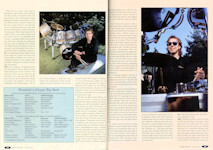
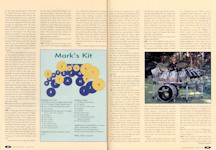
Page 80 Mark Brzezicki interview (cont.) know it's me. I do go through changes, although I always use Pearl drums and Zildjian cymbals. At the moment I'm using 13" Quick Beat hi-hat cymbals. They are very fast and thin-sounding, and very mic'-friendly. I use them all the time because they sound right to my ears. I go through phases of using different snare drums, but if possible I like to only use one at a particular time. For instance, sometimes I'll take about ten snare drums to a session, but once I've chosen one I'll try to stick to it. If a slight change in sound is required for a particular track, I'd rather make adjustments to the one I'm using than change to another one. I use the same ride cymbal on everything. I vary crashes, but I use the same splashes. The only thing I often vary is the rack tom situation. I like to have a range from small to large ones. I vary that often depending on how I feel. I'll sometimes set the kit up differently, just to stop myself from getting into a rut with my positioning. I was once quite paranoid about positions changing, to the extent that I used to say, "If I ever become successful, I'm never going to have a drum tech; I'll travel with the crew and set my own drums up." [laughs] But here I am now, lucky enough to be able to turn up and find the drums set up for me so that I don't have to touch a thing. If something does happen to be an inch out-which can seem like a mile on the drums-I won't let it bug me so much. I've learned over the years not to let things worry me, but just to get on with it. If you're doing a live festival and there's no time for a sound-check, you just have to go out there and play without letting things bother you. SG: Do you have any particular preferences when it comes to the materials that drums are made out of? MB: I find that I like the natural sound of thin-shelled drums because they "sing" more; but they are not always microphone-friendly. I do like the sound of maple, but I got out my birch kit recently and enjoyed that because it was a bit different. There is one kit that I love to use in the studio: It's one of my early kits, a Pearl fiber glass. It records well, but live it hasn't got a natural acoustic roar. So I'm quite happy to leave that in the studio and |
|||||||||||||||||||||||||||||||||||||||||||||||||||||||||||||||||||||||||||||||||||
 Back to top |
Page 82 Mark Brzezicki interview (cont.) take my maple kit out for live gigs. The snare drum, ride cymbal, and hi-hats are your sound; those are the things I'm particularly fussy about. If I'm going somewhere where I know I'll be getting a kit out of a box, I'll take my cymbal bag and a snare drum. Those are my fundamental requirements for feeling comfortable. Drumkits can vary around me. SG: Getting back to your career, it seems you've come full circle now that you have a regular band, Huge Big Thing, with Simon Townshend. Isn't it a bit strange that you are recording again with Big Country? MB: Well, I'm not actually a member of Big Country anymore. The band broke up about two years ago. I decided to carry on with the sessions, but also to make a commitment to form a band with Simon. When Big Country broke up, Simon and I agreed that we would do it for real now. We'd get a good band, good management, a good record deal, and give it a year and a half or so to get it on its feet. About five months later I got a call saying, "Big Country's back in action," which was rather strange for me because I'd originally tried to persuade them not to split up. At that time I'd made the commitment to Simon, I was touring with Fish, I was getting good response from new management - it was generally an exciting time. Although I'd been very disappointed when Big Country split up, I felt that I'd been to the funeral, and I now wanted to look forward to other things. They did a tour without me, and then asked me to play on their new album. At the moment they are talking about a tour. But my priority is Huge Big Thing, and allocating time can be difficult. SG: Is there anything in your career that stands out for you as something you are particularly proud of? MB: I'm very proud of playing with The Prince's Trust [a series of British all-star rock concerts for charity]. It was a thrill playing with Phil Collins. I'd never played along with another drummer before, and this was a unique experience. With him being left-handed and me being right-handed, we could be placed looking towards each other's hi-hats. I had to home in on certain areas. For instance, he would anchor the bass, snare, and hi-hat on some numbers, while I'd take care of the toms and ride. Then we might change around. We'd find our own level and get cross-rhythms going. I've been doing it for three years, and playing with Phil has been unbelievable; he's a superb musician. We did the Nelson Mandela show as well. Not only was that great, but it was one of the few opportunities I've had to play live with all these different people. Some of them I'd worked with in the studio, some of them were just people I'd admired. It was a fantastic experience. Playing "Sledgehammer" live was something I thought I'd never do unless I did a tour with Peter Gabriel, but here I was, doing it as one song in a set. There were people on stage with whom I'd worked but never thought I'd be out live with, like Joan Armatrading, Midge Ure, and Fish. I'd look over my ride cymbal and see Elton John playing piano; over to the left was Eric Clapton; in front of me was Mark King. There was this whole rainbow of musicians; it was a real personal high for me. I'd have to pinch myself when I came off stage and say, "I don't believe I've just done that!" [laughs] SG: How do you see your long-term future? MB: I'm into playing my drums, and success for me depends on how lucky I am with association. It's being in a successful band like Big Country, or playing on successful albums. It's weird when I get asked, "What's it like being a rock star?" because I don't know! I don't think that if you're a real person you'll ever know. You just deal with whatever you have to deal with. I deal with playing my drums; and I'm as frustrated now as the day I started. I want to know more. I want to be happier with my playing. I want to sound better. As I've said before, the further you go down that road, the further you want to go. |
|||||||||||||||||||||||||||||||||||||||||||||||||||||||||||||||||||||||||||||||||||